Content
If you manage logistics for an automotive plant or a tier-one parts supplier, you already know the pressure. A single vehicle is assembled from roughly 30,000 individual parts, ranging from tiny fasteners to bulky doorframes and fragile bumpers. These parts arrive from dozens of suppliers, must be stored without damage, and then delivered to the line in the exact sequence required by just-in-time (JIT) and just-in-sequence (JIS) production schedules. The margin for error is measured in minutes, not days.
Generic warehouse equipment simply doesn't cut it. A standard pallet rack or a one-size-fits-all container cannot protect a stamped steel door panel or stabilize a heavy engine block during transit. That is why automotive material handling requires a dedicated approach—one built around unitized metal containers, specialized racks, and work-in-process equipment designed for the peculiar demands of vehicle manufacturing.
This guide focuses on the practical, non-automated backbone of automotive parts handling: foldable steel stillages, wire mesh containers, roll cage trolleys, and custom racks for engines, doorframes, bumpers, and stampings. You will learn what challenges to expect, which equipment suits which job, and how to build a selection framework that protects parts, saves floor space, and controls return logistics costs.
Before selecting any equipment, it pays to understand the specific pain points that make automotive logistics distinct from, say, e-commerce fulfillment or food distribution. The following challenges recur across nearly every plant we encounter.
Multi-model production lines are now the norm. One assembly plant may build three or four different vehicle models on the same line, which multiplies the number of active part numbers dramatically. Mixed-flow production forces logistics teams to separate, label, and sequence parts with extreme precision. The result is a constant tug-of-war: slow-moving parts sit in inventory too long while fast-moving parts risk stockouts. Unitized containers with clear labeling zones and standardized footprints help bring order to this variety, allowing you to consolidate parts by model or production batch without losing traceability.
Large thin-walled components—doorframes, bumpers, hoods, and stamped body panels—are notoriously prone to scratches, dents, and deformation. A single damaged panel can halt a production line or require costly rework. Heavy components such as engine blocks and transmission housings present a different risk: they need stable, fixed positioning to prevent shifting during transport and stacking. Dedicated locating fixtures, custom-cut foam inserts, and purpose-built rack structures are not optional add-ons; they are the primary defense against part damage. In our experience, investing in custom racks that mirror the geometry of the part is the single most effective way to reduce defect rates in inbound logistics.
Materials must arrive at the assembly line in the right sequence, at the right time, and in a condition that allows operators to retrieve them without extra handling. Every minute spent repositioning a container or hunting for a part at the line side is wasted labor. The equipment you choose directly influences this rhythm. Wheeled cage trolleys, for instance, allow pickers to move parts from the goods-in area to the line without transferring them to another carrier. Foldable containers that can be stacked when full and collapsed when empty reduce the turnaround time of return logistics. If your carriers take too long to cycle back to suppliers, you end up leasing extra containers or buying more inventory to cover the gap—both are expensive outcomes.
Automotive plants are dense environments. Forklifts share aisles with manual trolleys, and operators frequently bend, reach, and lift heavy parts. Repetitive manual handling of engine parts or large stampings is a leading cause of workplace strain injuries. Compliance frameworks such as OSHA guidelines in the United States and ISO 45001 elsewhere push for ergonomic design in material handling. Equipment with proper grab heights, fixed casters, and stable stacking points reduces the physical load on workers. Containers that are too heavy when empty, or racks that wobble during transport, are safety hazards as much as operational inefficiencies. Choose carriers that are designed for the weight they carry and for the workers who handle them daily.
Once you know the challenges, the equipment landscape becomes easier to navigate. The table below summarizes the main categories relevant to automotive parts handling, followed by a detailed breakdown of each type.
| Equipment Type | Primary Use | Key Advantage | Typical Parts |
|---|---|---|---|
| Foldable steel stillage | Dense storage, return logistics | Collapses for empty return, stacks when full | Small parts, castings, semi-finished goods |
| Wire mesh container | Visible storage, versatile handling | See-through design, ventilated, stackable | Standard parts, fasteners, subassemblies |
| Roll cage trolley | Line-side feeding, order picking | Wheeled mobility, flexible access | Mixed loads, sequenced kits, retail parts |
| Custom rack (engine, doorframe, bumper) | Protective transport of shaped parts | Locating fixtures prevent damage | Engines, doorframes, bumpers, stampings |
| Stacking rack | Heavy or non-standard loads | Rigid structure, high load capacity | WIP, heavy castings, finished subassemblies |
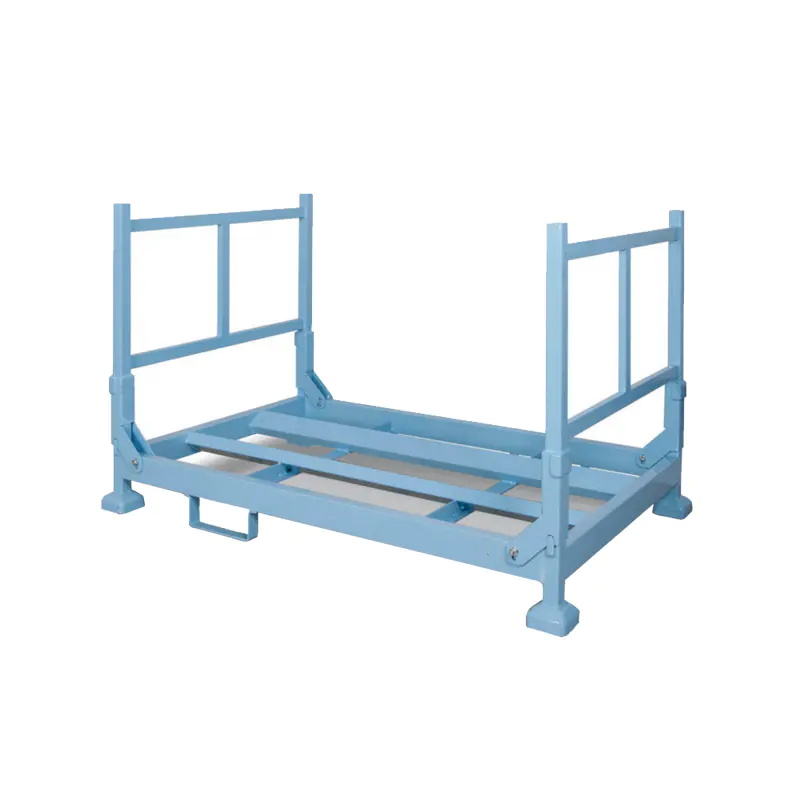
A foldable steel stillage is a rigid container with hinged sides that fold flat when empty. When loaded, it stacks securely with other units, using vertical warehouse space efficiently. When empty, it collapses to roughly one-third of its full height, which dramatically reduces the cost of returning containers to suppliers. The volume savings during empty return alone can cut transport costs by up to 60% compared to rigid containers.
Most stillages in automotive use are built to Euro pallet footprints (800 × 1200 mm or 1000 × 1200 mm), which integrate seamlessly with standard racking and conveyor systems. However, custom dimensions are common when parts dictate the size. The trade-off is simple: standard sizes offer faster lead times and lower cost, while custom sizes maximize space utilization for specific part families. For a deeper look at the operational benefits, see our article on how foldable steel stillages improve logistics efficiency.
The euro foldable steel stillage is a workhorse unit in this category, designed for loads up to 1000 kg with a stacking capacity that suits both parts distribution and long-term storage.
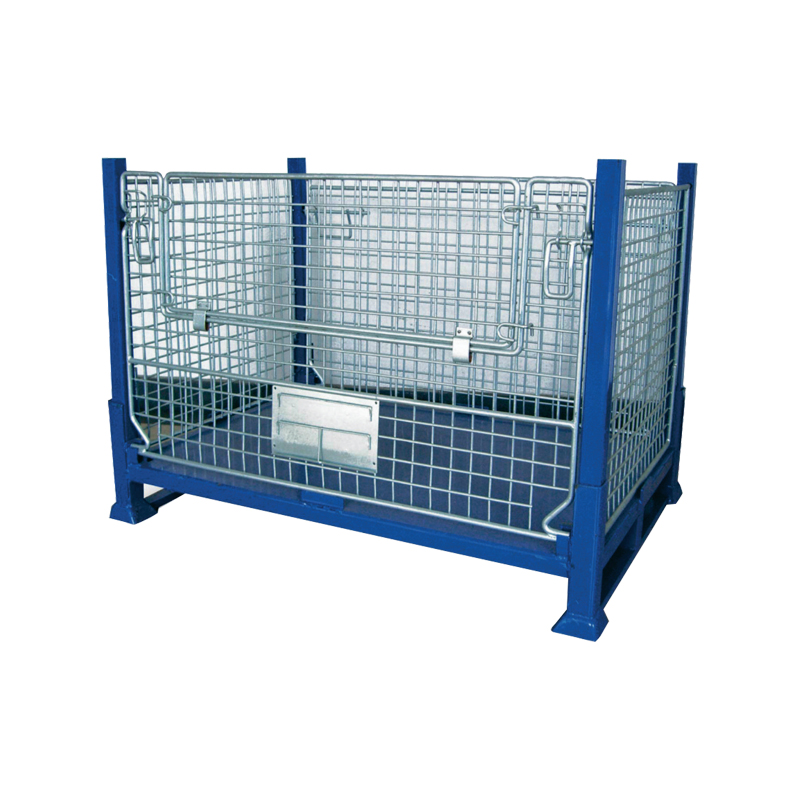 Wholesale Euro Foldable Steel Stillage Suppliers, Manufacturers - Shanghai BetisShanghai Betis Logistics Equipment Co., Ltd. is China wholesale Euro Foldable Steel Stillage suppliers and OEM/ODM manufacturers, details...View Product →
Wire mesh containers offer what solid-wall units cannot: visibility. Operators can identify the contents and remaining quantity from a distance without opening the container, which speeds up picking and reduces the risk of sending the wrong part to the line. The open mesh also allows airflow, which is useful for parts that need to cool down after painting or washing. These containers typically stack with or without lids, and many models fold flat when empty.
Mesh containers shine for standard parts, small components, and semi-finished goods that do not need custom locating fixtures. They are also a favored intermediate bulk container between the supplier and the plant. Before choosing between mesh and solid bins for a specific operation, read our practical comparison on comparing mesh containers and solid bins to understand the trade-offs in protection, visibility, and cost.
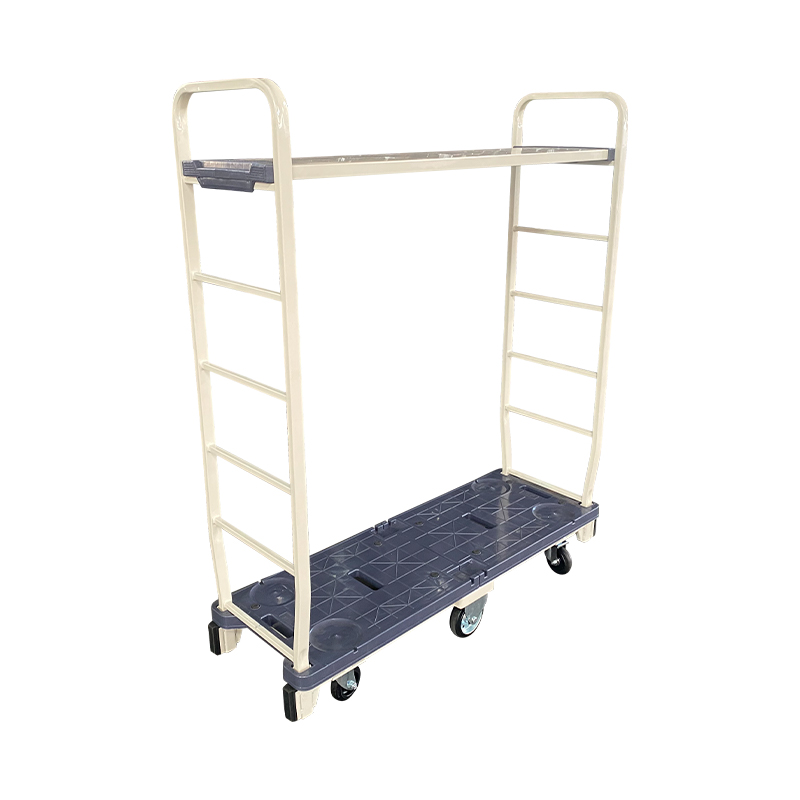
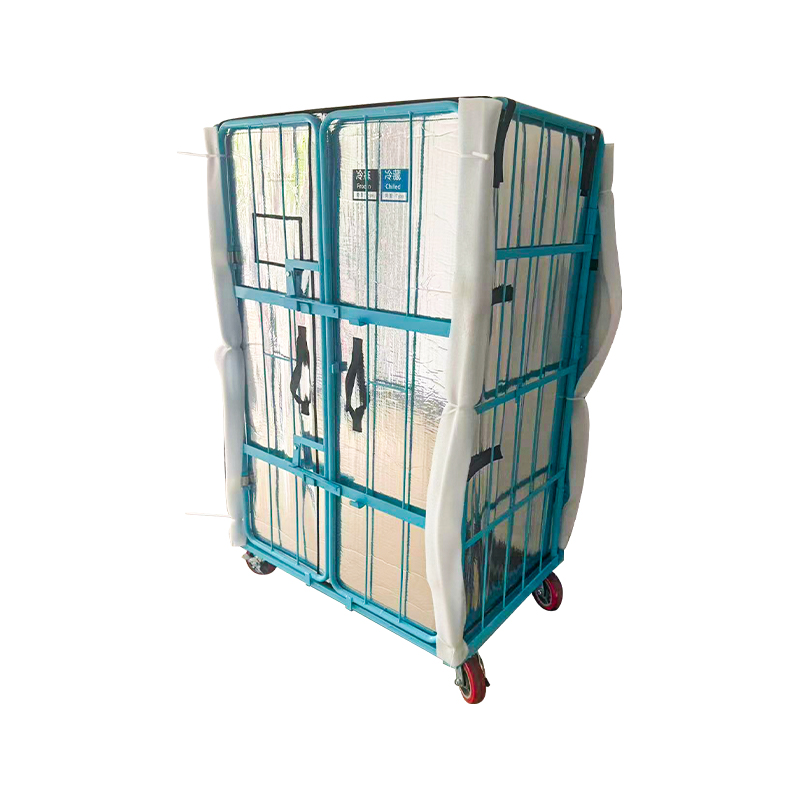
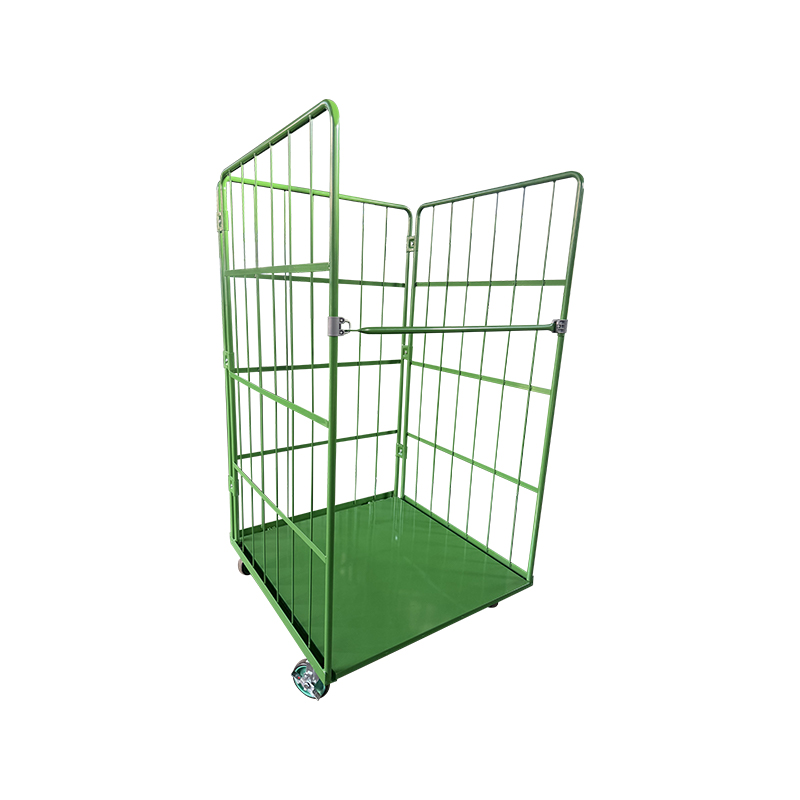
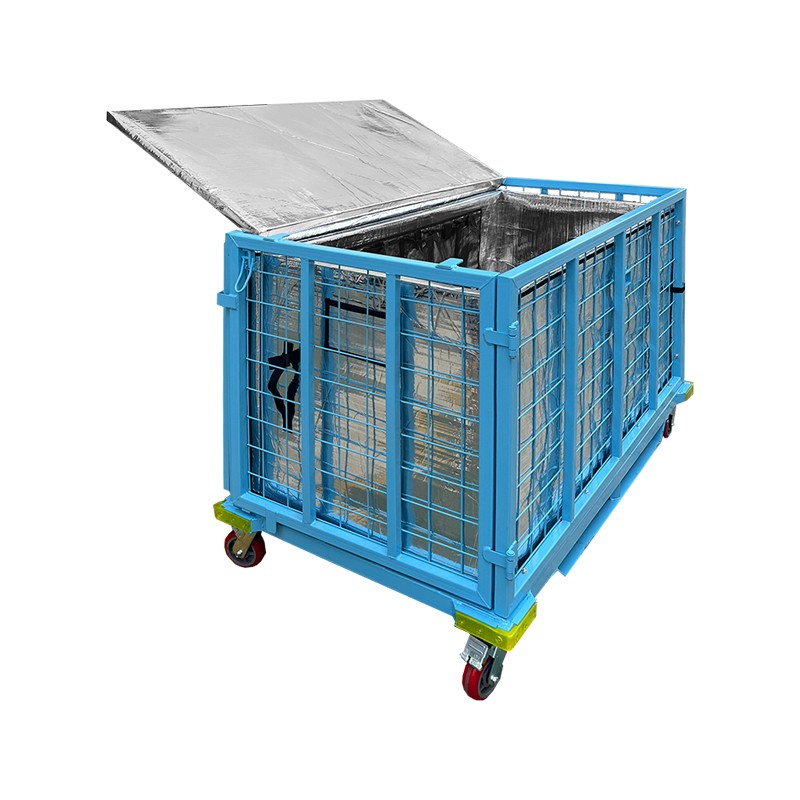
Roll cage trolleys are wheeled carriers that combine a base with a cage structure—typically mesh walls and a hinged gate. They are the go-to solution for internal distribution and picking because they move parts directly from the storage area to the line side without re-handling. In the aftermarket parts business, cage trolleys also serve as picking carts for filling customer orders.
The variety is wider than it first appears. L-type cage trolleys have a gate that spans the full length of one side, ideal for loading long parts. Models with mesh walls provide visibility, while those with solid sides protect parts from dust and minor impacts. Some designs incorporate a plastic pallet base that reduces weight and increases corrosion resistance. Choosing the right one depends on your load profile, aisle widths, and whether you need to fold the trolley for empty return. When you are ready to narrow down a specific model, our guide to choosing the right roll cage trolley model walks through the decision criteria in detail.
This is where automotive material handling becomes truly specialized. Dedicated racks are engineered around the geometry of a specific part. An engine rack, for example, has locating pins that hold the block in a precise position, preventing movement during road transport and stacking. The rack itself is designed to stack with other racks when loaded, which multiplies the utilization of floor space in both the warehouse and the truck.
For large, thin parts like doorframes and bumpers, the rack uses cradles, clamps, or padded supports that match the contour of the part. This prevents the flexing and scratching that happens when parts are simply stacked on flat surfaces. The engineering goal is to maximize part density while maintaining zero contact between parts—a balance that requires close collaboration between the rack designer and the logistics engineer. For more on the broader topic of storing and inventorying these parts, our article on automotive parts storage and inventory solutions covers the space-planning side in depth.
For engine storage specifically, the stackable automotive engine storage rack is engineered to support the weight and geometry of engine blocks while enabling high-density vertical stacking. For doorframes, bumpers, and stampings, custom metal stillages for doorframes and bumpers provide the contour-following cradles and side supports that keep large panels stable without surface damage.
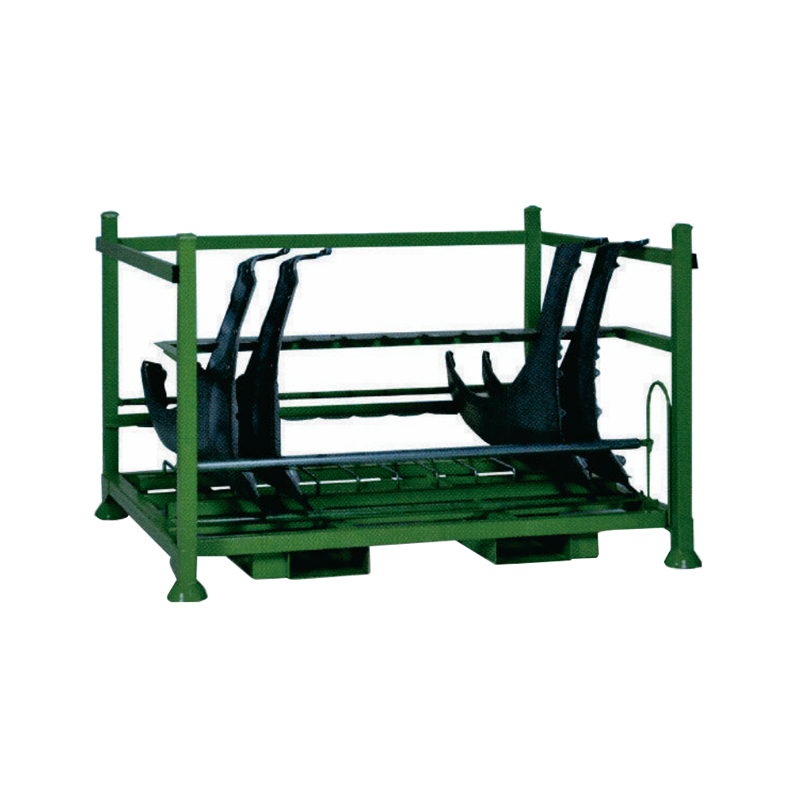 Wholesale Metal Stillages for Automotive door-frame/Bumper/Stamping Parts SuppliShanghai Betis Logistics Equipment Co., Ltd. is China wholesale Metal Stillages for Automotive door-frame/Bumper/Stamping Parts suppliers...View Product →
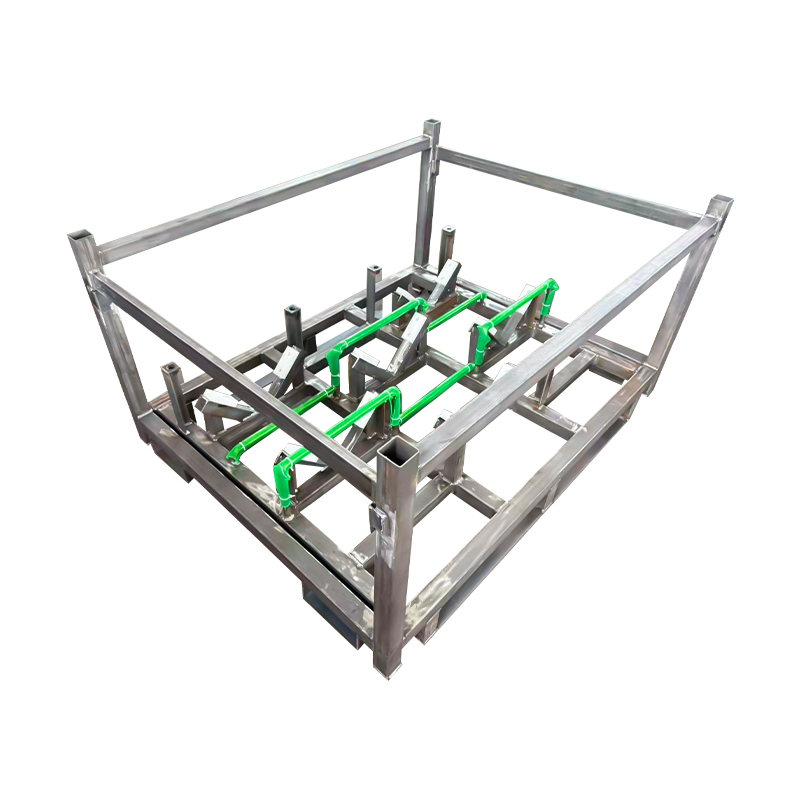 Wholesale Stackable Automotive Engine Storage Rack Suppliers, Manufacturers - ShShanghai Betis Logistics Equipment Co., Ltd. is China wholesale Stackable Automotive Engine Storage Rack suppliers and OEM/ODM manufactur...View Product →
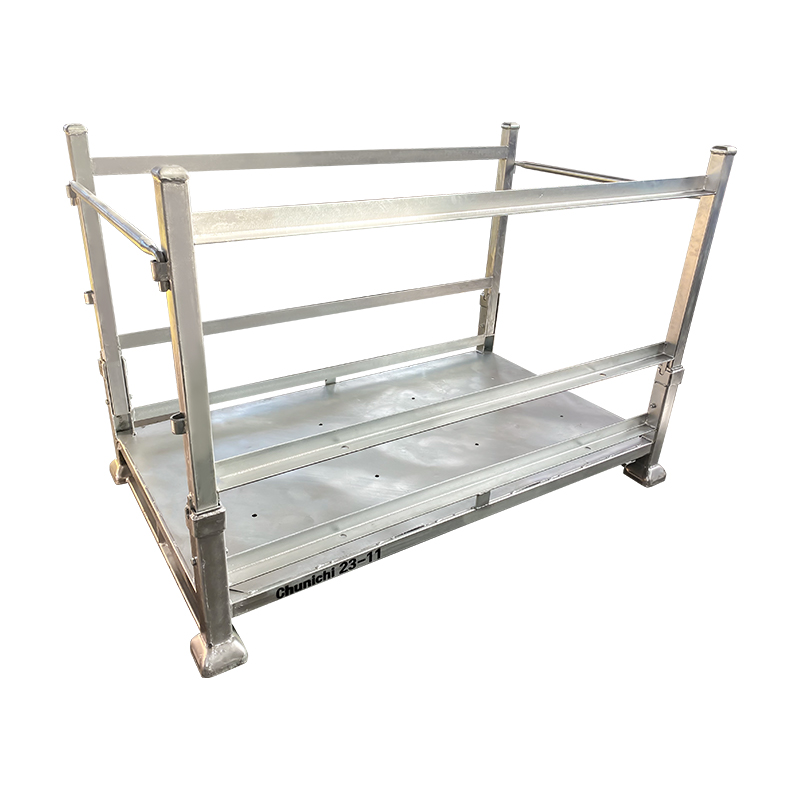
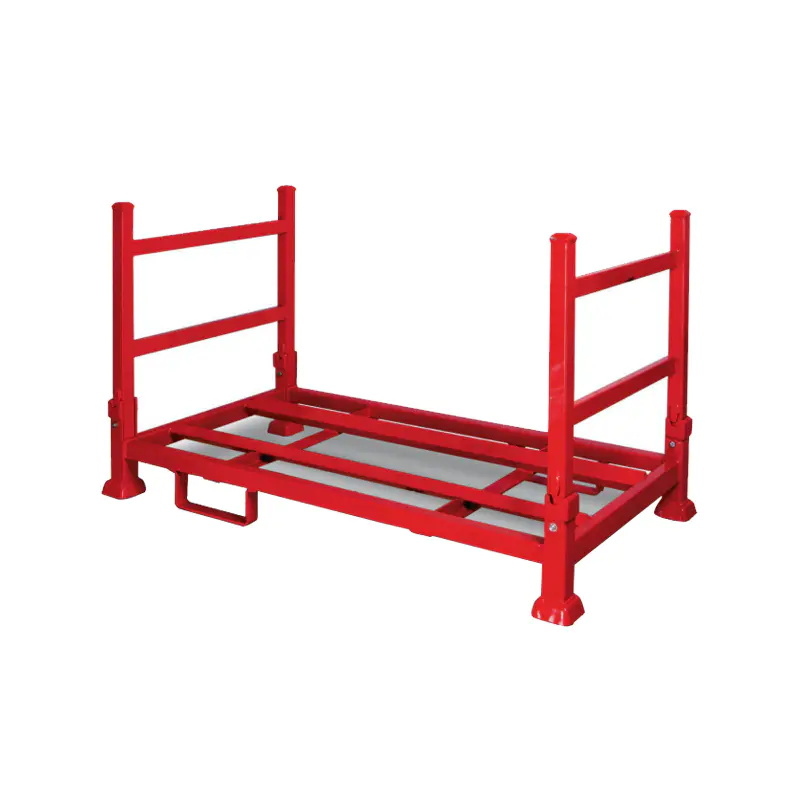
When a load is too heavy for a standard stillage or too odd-shaped for a cage trolley, a stacking rack is the default choice. These racks are built with structural steel frames, often hot-dip galvanized for corrosion resistance, and are designed to stack three or four units high with heavy loads. Inverted stacking racks use the load itself as part of the stacking structure, which reduces the overall height of the loaded unit. This design works well for large fabrications that can bear compressive loads.
Stacking racks serve double duty for work-in-process (WIP) turnover and finished goods storage. Because they are rigid and stackable, they make efficient use of vertical space in the warehouse. For load capacities above 500 kg and up to several tons, a stacking rack is often the only practical unitized solution. The main consideration is the total weight per stack and the floor loading capacity of your warehouse.
Selection is rarely about picking a single "best" container. It is about fitting equipment to your specific material flow, part characteristics, and return logistics. The following steps provide a structured decision framework.
Start with a diagram of how parts physically move through your operation: from goods reception to storage, from storage to the line side, and from the line side to final assembly or shipping. Mark every point where parts wait, where they are re-handled, and where damage or delay occurs. These are your improvement priorities. Equipment should be selected to reduce the number of touches and waiting time at those specific nodes, not to fill an empty racking bay.
Weight, shape, fragility, and turnover frequency determine the right equipment category. Ask yourself: Does the part require positioning fixtures to prevent damage? If yes, plan for custom racks or stillages with internal supports. Does it come in high volumes from a single supplier? Then standard foldable containers make sense for pooling and return logistics. Is the part heavy and irregularly shaped? A stacking rack with a high load rating is more appropriate than a wire mesh container. Also consult a material handling racking systems selection guide for a broader view of racking options and safety considerations that apply across the facility.
Every container you send to a supplier must come back—empty. That return trip costs money, and the cost is directly proportional to the volume the empty container occupies. Foldable and nestable designs are the most powerful lever you have here. A foldable stillage reduces the cubic volume of empty returns by roughly two-thirds. This allows you to either reduce the number of trucks on the road or carry more supplier shipments per vehicle. Standard container sizes also simplify pooling and tracking across multiple suppliers. Before committing to a custom size, verify that the space savings on the loaded trip outweigh the empty-return volume penalty.
Standard products win on price and lead time. If a standard wire mesh container or a Euro stillage fits your part dimensions and weight, it is almost always the right economic choice. Custom racks, however, are irreplaceable when standard containers cannot protect the part geometry—think doorframes, bumpers, or engine blocks. The decision rule is practical: customize only when the cost of part damage or the inefficiency of a poor-fitting standard unit exceeds the engineering investment for a custom solution. When you do need customization, plan for a longer design phase, prototype testing, and factory acceptance testing before mass production.
Choosing the right equipment is only half the battle. The other half is ensuring it works in the chaos of a real production environment. Based on our work with automotive parts manufacturers, the following practices consistently improve project outcomes.
Start with a small pilot batch. Do not roll out a new rack or container across the entire plant at once. Instead, introduce a limited quantity—say, enough for one production line or one supplier lane—and monitor how the equipment performs in daily use. This limits your exposure to design flaws and gives the project team room to adjust.
Get feedback from the operators who handle the equipment. The people who load, unload, and move the containers every day notice ergonomic issues that engineers miss. If a rack is difficult to stack or a trolley is hard to steer when loaded, operators will tell you. Run a formal feedback session after the pilot period and be prepared to iterate on handle heights, caster sizes, and gate designs.
Use factory acceptance testing (FAT). Before a custom rack is mass-produced, test a sample unit at the manufacturer's facility. Load it with the actual parts, stack it to the specified height, and simulate the transport conditions. This is the cheapest time to catch structural or clearance problems, long before the rack is in daily service at your plant.
Plan training and maintenance from day one. Standardized loading instructions, clear labeling, and periodic inspections prevent misuse. Casters, hinges, and locking mechanisms wear out over time; a simple quarterly maintenance checklist extends the life of the equipment and prevents safety incidents. In our experience, plants that skip these steps end up with damaged containers and injured workers within the first year.
Automotive material handling is rarely glamorous, but it is the connective tissue between your suppliers, your warehouse, and your assembly line. The equipment you choose shapes part quality, line-side delivery speed, and the cost of moving empty containers back to suppliers. Unitized metal containers—foldable stillages, wire mesh containers, roll cage trolleys, and custom racks—are the foundation of a system that protects fragile parts, uses vertical space, and keeps return logistics economical.
When evaluating your options, assess every candidate against three criteria: Does it protect the part? Does it use space efficiently? Does it reduce the cost of the round trip? If a standard product meets all three, use it. If not, a customized rack or stillage is a justified investment, especially for the high-value, irregularly shaped parts that define so much of automotive logistics. Start by mapping your own material flow, talk openly with equipment suppliers about your part mix and volumes, and test before you commit at scale. A deliberate approach now will save you from costly rework and line stoppages later.

Copyright © 2024 Shanghai Betis Logistics Equipment Co., Ltd. All Rights Reserved.
 Custom Metal Storage Cages Manufacturers

 English
 中文简体
中文简体 日本語
日本語